Choose the operating environment first, then the matching payment option. EasyManageX plans shared and dedicated server setups with monthly or lifetime licences, plus a distinct self-managed software purchase for your own environment. Server service, storage, usage credits and support need their own agreed terms. The catalogue and prices are illustrative; availability, package contents and delivery must be confirmed in a proposal.
- Shared and dedicated server setups support monthly or lifetime licences; a self-managed software package is purchased separately.
- Compare licence rights and handover with infrastructure, storage, updates, backups and support costs.
- Treat offline access, customer-owned storage sync and Intellistra AI as planned capabilities that need a demonstrated acceptance scope.
Separate server resources from software licence rights
Build a worksheet with separate rows for the software licence and the operating service. The licence row names the agreed Micro-ERP, active-team capacity, permitted organization and environments, payment option and use rights. The service row names the server setup, operator, resource limits, monitoring, backups and support. This separation prevents an attractive one-time licence price from being mistaken for a complete managed service.
EasyManageX uses fixed active-team bands of 1–10, 11–30 and 31+ rather than a per-seat calculation. The selected core app has the same agreed feature coverage across those bands. Record the actual capacity in the proposal, including any larger-team assessment. Published catalogue examples do not approve a workspace tariff, storage quota or usage rate, so carry unknown amounts into the discussion instead of assuming they are included.
Compare shared and dedicated server responsibilities
A shared server option uses an agreed shared environment; a dedicated server option defines a separate server environment and its resource allocation. Ask what is dedicated, how capacity is measured, and which administration tasks the service includes. Neither label proves a particular speed, isolation standard, availability level or backup result. Those requirements need explicit scope and evidence suitable for the business workflow.
For either hosted setup, name who controls application access, applies updates, checks failed jobs and responds to incidents. Ask how records and attachments can be exported, who requests a restore, and when recovery tests occur. Agree the server service fee separately from the monthly or lifetime software licence. Included hosted storage and actual GB-month overage also need confirmed quotas and rates; no numeric allowance is approved by this guide.
Define the self-managed software purchase package
The self-managed option is a distinct one-time software purchase for an environment your team operates. It is not a hosted monthly or lifetime subscription. Before accepting an offer, list the delivered package, installation instructions, supported database, permitted deployments, configuration material and acceptance steps. Your organization pays its own infrastructure and storage costs and needs an operator who can maintain that environment.
A software purchase does not automatically establish unrestricted copying, source-code access, exclusive intellectual-property ownership or a right to resell the product. Agree licence rights, package contents and handover explicitly. Record how updates, dependency changes, restoration and support are handled after delivery, and which services cost extra. Test a clean installation and a recovery scenario using agreed sample data before treating handover as complete.
Read the hosted lifetime licence boundaries
A hosted lifetime licence removes recurring software licence renewal for the agreed scope. Shared or dedicated server service continues under its own agreement; usage credits, storage overage, updates and support terms remain separate. Confirm what version and feature scope the licence covers, how capacity changes are handled, and what happens if the server service ends. Compare the entire operating commitment over the same period.
Monthly licensing is another payment choice for the same hosted setup. It can be useful when a business wants to evaluate an agreed scope before making a larger licence commitment, but cancellation, migration and support rules still need a proposal. For both payments, verify activation and replacement-environment procedures. Keep a written distinction between permission to use the software and the services needed to run it.
Plan offline work, storage sync and AI separately
EasyManageX plans offline use of configured, locally available core workflows after setup. The proposed limit is 48 hours from the last successful authorized service verification. At or after that deadline, ERP use pauses while pending local changes are preserved. Reconnecting must complete successful service verification before unlocking and syncing supported changes. Internet connectivity alone does not reset the deadline, and sync conflicts require visible review rather than a silent overwrite.
Sync to a customer-owned drive or database is also planned. A proposal must identify supported files or structured records, connector access, schema mapping and sync direction. Provider charges remain the customer’s responsibility, and a retained hosted copy may still have storage costs. Planned inbuilt Intellistra assistance, automation and custom workflow design require internet, approved ERP context and purchased usage credits. Supported actions, permissions and approvals must be agreed; these plans do not promise that AI can execute any task.
Use a repeatable selection and acceptance workflow
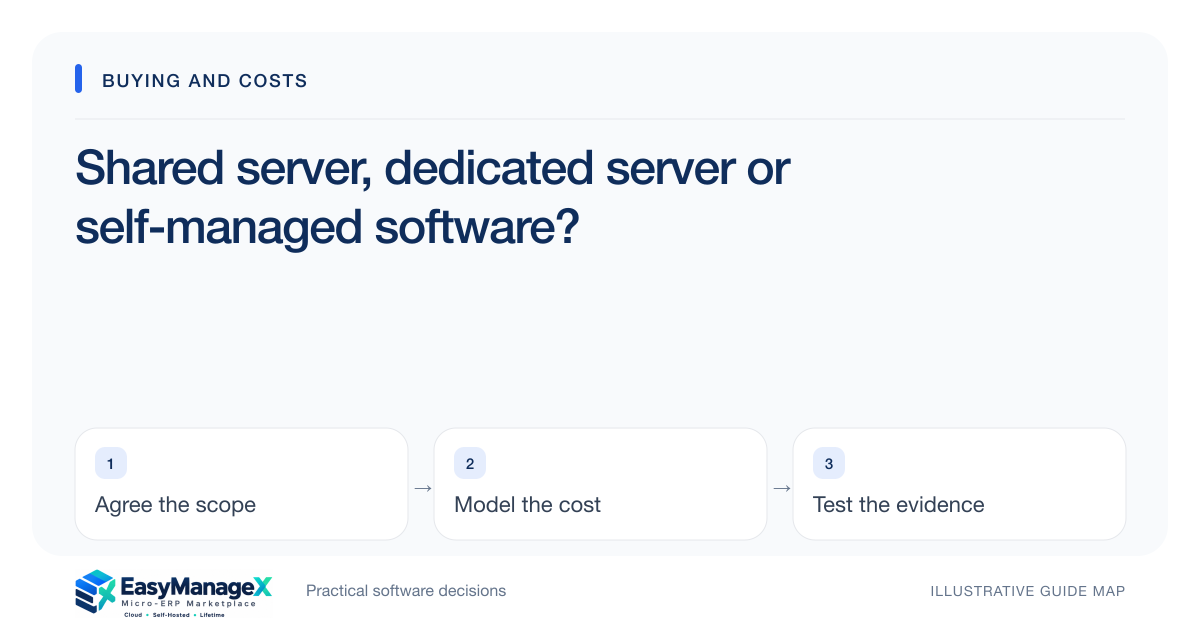
Consider an illustrative service business comparing all three setups with the same core workflow and active team. First, identify access and control needs. Second, name the person who will operate the environment. Third, select hosted monthly or lifetime payment, or the separate software purchase. Fourth, list licence, server, storage, usage, migration and support amounts independently. Ask the provider to resolve missing figures and responsibilities before comparing totals.
Finish with acceptance evidence: demonstrate the agreed records, permissions and exceptions; test exports and recovery; and document handover and support escalation. If offline use, own-storage sync or Intellistra is essential, require a working demonstration and written acceptance scope when those capabilities become available. They are not running features on this marketplace website today. Carry the worksheet into a requirements brief so the business, technical and commercial owners can make the same informed decision.
Your working checklist
- Choose shared server, dedicated server or a self-managed software purchase before comparing payment options.
- Record the active-team band and the agreed core app scope.
- Separate licence price from server service, storage, usage credits and support costs.
- Agree package contents, permitted environments, licence rights and handover evidence.
- Name the operator responsible for updates, backups, restoration and access reviews.
- Confirm export, cancellation, replacement-environment and migration procedures.
- Request demonstrations and acceptance criteria for planned offline, own-storage sync and Intellistra capabilities.
Common questions
Does a hosted lifetime licence remove every recurring cost?+
It removes recurring software licence renewal for the agreed scope, not every operating charge. Shared or dedicated server service, usage credits, actual storage overage, updates and support may remain separate. Ask the proposal to identify each charge and responsibility so the complete workflow cost is visible before selecting a payment option.
What does the self-managed software purchase include?+
It is a distinct one-time package for your own environment, with contents, licence rights, handover and maintenance agreed in the proposal. Your infrastructure and storage remain your responsibility. Do not infer source-code delivery, unrestricted resale rights or exclusive intellectual-property transfer from the purchase label; confirm the actual package and permitted use.
Can I change server setup or sync to my own storage later?+
A move needs a supported export, an agreed migration route and clear operator responsibilities. Customer-owned drive or database sync is planned and limited to proposal-confirmed connectors and data scope. Confirm permissions, schema, sync direction and provider charges. It does not remove the planned requirement for successful authorized service verification within 48 hours.
Are offline mode and Intellistra automation available now?+
They are planned Micro-ERP capabilities, not implemented runtime services on this marketplace website. The proposed offline policy pauses use at the verification deadline and preserves pending changes. Planned Intellistra AI and automation require internet and usage credits, with supported actions and approvals defined in the final scope. Request working evidence when delivery is proposed.
Sources and further reading
These primary references explain relevant concepts. Our scenarios and working checklists are original, illustrative guidance.
- AWS Well-Architected Reliability Pillar
Recovery, resilient operations and reliability decisions.
- AWS Well-Architected Cost Optimization Pillar
Cost ownership and measuring resource spending, not ERP price benchmarks.
- NIST Small Business Cybersecurity Corner
Business security planning and owner responsibilities.
Published by EasyManageX as practical, AI-assisted guidance. Examples are illustrative. Confirm software capabilities, licence terms and project-specific requirements before committing. Read our editorial policy.